Pouches & Specs
Every format, size, material, finish and feature we build - with the published source behind each number, and an honest mark where the public record is silent.
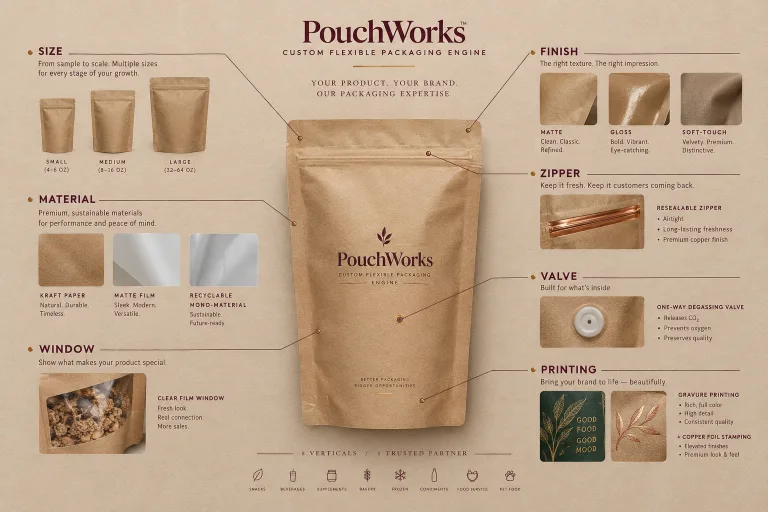
Eight ways to build a bag
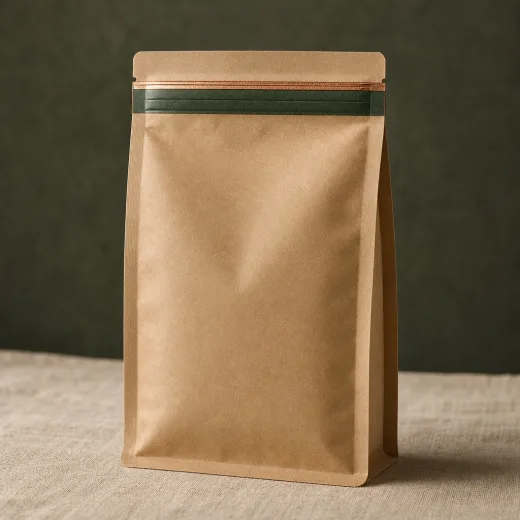
Stand-Up Pouch
The retail workhorse. Bottom gusset lets it stand and face front on shelf.
Viable for cat food and smaller animal feed as well as general retail.
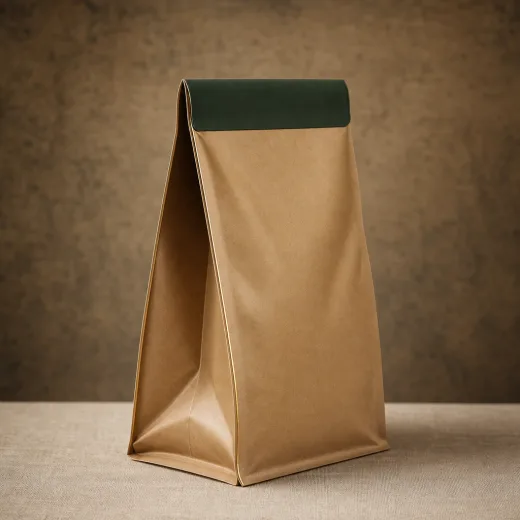
Side-Gusseted Bag
Classic large-format bag. Expands at both sides for high fill weights.
Ideal for large format; conforms well to pellets and handles heavy weights.
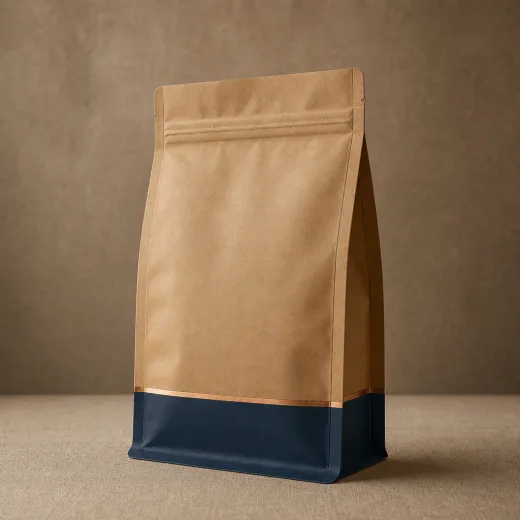
Flat Bottom / Box Pouch
Five printable panels and a true square base. The premium shelf presence.
Suitable for smaller weights (5-10 lb); accommodates up to 25 lb in pet food use.
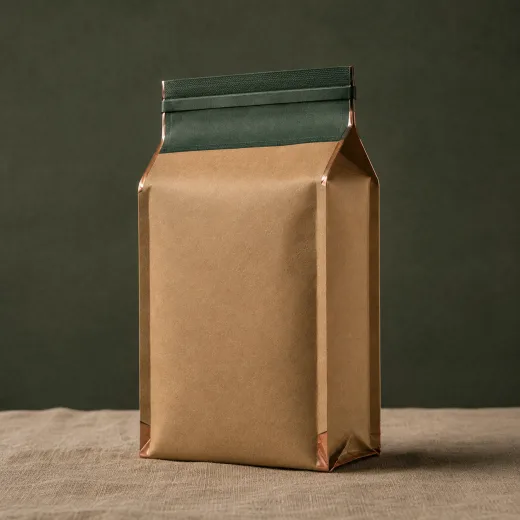
Quad-Seal Pouch
Four sealed corners for structural rigidity without a reclosure.
Known for durability; does not require zipper reclosure.
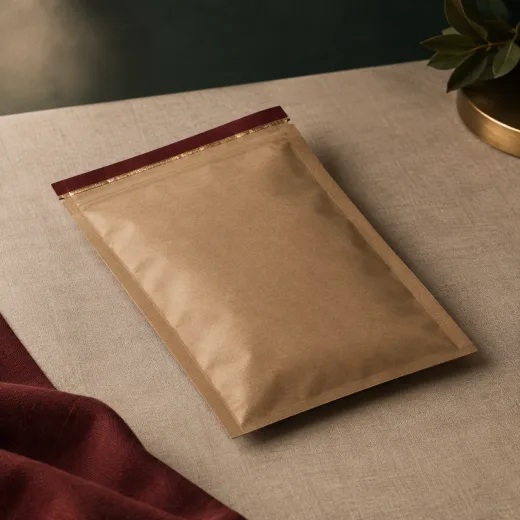
Flat Pouch / 3-Side Seal
Lay-flat, low-material format for single-serve and sample sizes.
Listed among standard bag configurations alongside stand-up and side-gusseted.
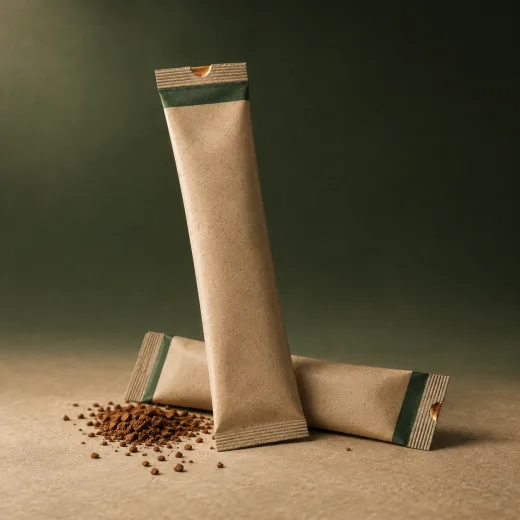
Stick Pack / Sachet
Single-dose column format for powders, seasonings and instant blends.
Offered as a distinct custom-printed format.
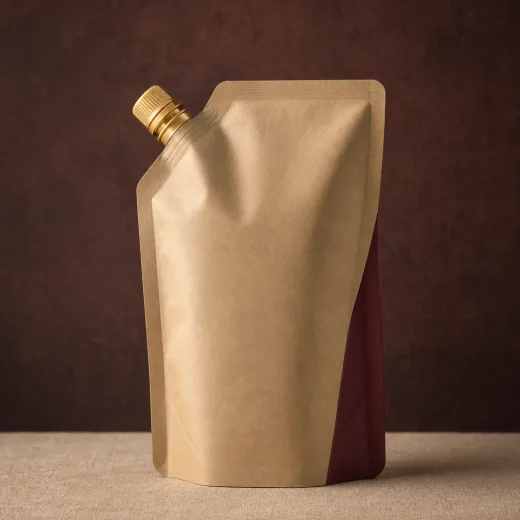
Spouted Pouch
Fitment-and-cap pouch for liquids, purees and pourables.
Spouts listed as an available add-on feature/configuration.
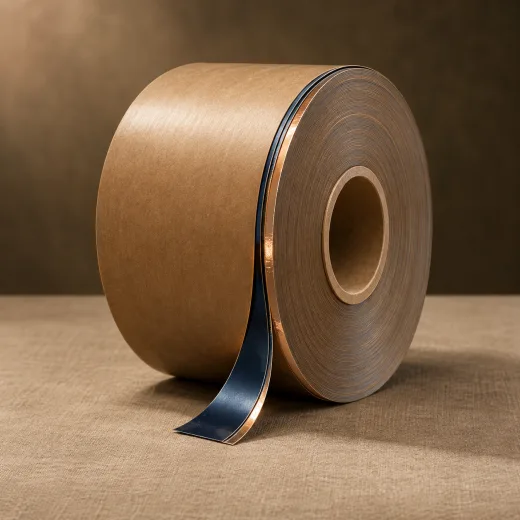
Printed Rollstock Film
Printed laminate on the roll for brands running their own form-fill-seal line.
PET/AL/PE printed film roll offered as roll stock prior to conversion.
Three builds people ask for by name
Variants of the formats above rather than separate tooling. If one of these is what you had in your head, say so on the brief and we will spec it.
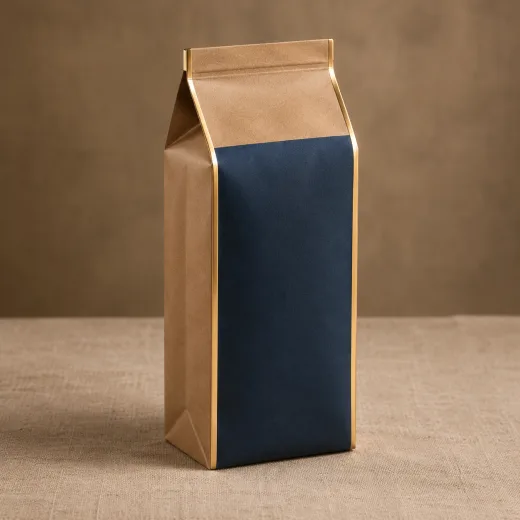
Box pouch
The flat-bottom family run tall and narrow. Two full side panels on top of the front, back and base give you five printable faces, which is more shelf surface than most brands realise they can buy.
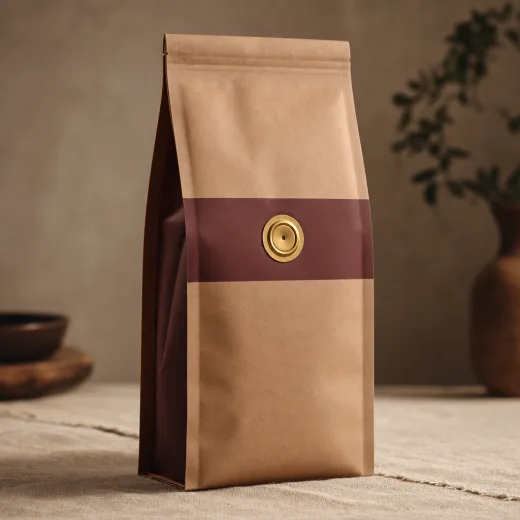
Valve bag
A side-gusseted bag with the one-way degassing valve fitted. It vents the CO₂ a fresh roast gives off without letting oxygen back in, which is why it is effectively mandatory on coffee.
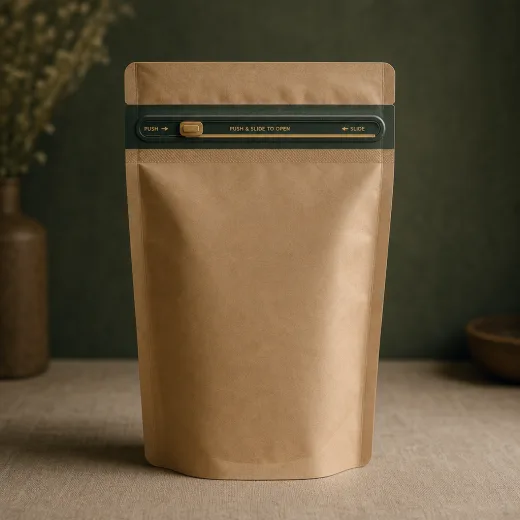
Child-resistant closure
A push-and-slide closure fitted to a standard stand-up pouch.
Shown because we are asked for it. It is not on our sourced spec sheet yet, so we confirm tooling and certification with you before it goes into a quote.
Standard size ladder
Capacity varies with your product's bulk density - these are starting points for a fill trial, not guarantees.
| Dimensions (W × H + gusset) | Fill volume | Granular | Powder | Liquid | Typical use |
|---|---|---|---|---|---|
| 3.5 × 5.5 + 2" | 2-4 fl oz | 1-2 oz | 2-3 oz | 2-3 fl oz | Coffee samples, single-serve supplements (30 g) |
| 4 × 6 + 2" | 4-6 fl oz | 2-4 oz | 3-5 oz | 4-5 fl oz | Snacks 2-3 oz, pet treat sample 3-4 oz |
| 5 × 8 + 2.5" | 8-12 fl oz | 4-8 oz | 6-10 oz | 8-10 fl oz | Coffee 12 oz - the retail standard; snacks 6-8 oz |
| 6 × 9 + 3" | 12-16 fl oz | 8-12 oz | 10-16 oz | 12-14 fl oz | 1 lb retail supplements, pet treats 8-12 oz |
| 7 × 11 + 3.5" | 24-32 fl oz | 16-24 oz (1-1.5 lb) | 20-32 oz | 24-28 fl oz | Coffee 2 lb, snacks 16 oz |
| 8 × 12 + 4" | 32-48 fl oz | 24-32 oz (1.5-2 lb) | 32-48 oz | 32-40 fl oz | Large pet treats 24-32 oz, snacks 24-32 oz |
| 9 × 13 + 4" | 48-64 fl oz | 32-48 oz (2-3 lb) | 48-64 oz | 48-56 fl oz | Coffee 5 lb bulk, 5 lb supplements |
| 10 × 15 + 4.5" | 64-96 fl oz | 48-80 oz (3-5 lb) | 64-96 oz | 64-80 fl oz | Bulk / food-service fills |
Size and capacity table published by Cubit Packaging, accessed 2026-09-08. Capacity ranges are the publisher's stated guidance and vary with product bulk density. Treat as a starting point for fill trials, not a guarantee. Independently corroborated against PackFreshUSA's 5-mil ladder, which publishes capacity on a water-fill basis - a different measure, so the two are not directly comparable.
Laminate structures
The structure decides the shelf life. Everything else is presentation.
PET / PE
- Barrier
- Moderate
- Published OTR
- Not published - Not published on the sources read.
- Look
- Clear or reverse-printed with a window
Entry structure where product visibility matters more than long shelf life.
Source: carepac.com
PET / VMPET / PE
- Barrier
- High
- Published OTR
- Not published - Not published; metallized PET optical density stated at 1.4-3.0 with metal/film bond 100-150 gm/25mm (plain side), 130-180 gm/25mm (corona side).
- Look
- Silver metallic or printed over metallized
Most of the foil barrier at lower cost and better flex-crack resistance.
Source: carepac.com
PET / AL / PE
- Barrier
- Maximum
- Published OTR
- ≈0.005-0.006 (WVTR and OTR near zero)
- Look
- Opaque, full-surface print
PET outer for strength/heat resistance, aluminium foil middle for barrier, PE inner sealant (melt point ≈110 °C). Recommended for moisture-sensitive foods, oils/fats prone to oxidation, and UV-sensitive teas and spices.
Source: carepac.com
Kraft / Foil or Kraft / PE
- Barrier
- Moderate to Maximum depending on liner
- Published OTR
- Not published - Depends on the chosen liner; not published per-structure.
- Look
- Uncoated kraft paper exterior, earthy matte hand-feel
Kraft paper and plastic film are the two most common exteriors; both can be laminated with a foil lining for longer shelf life. Commonly run at 5-6 mil in stock ranges for an earthy retail feel.
Source: carepac.com
Mono-Material PE (Recyclable)
- Barrier
- Moderate to High
- Published OTR
- Not published - Not published on sources read.
- Look
- Clear or printed, matte or gloss
- Certified
- How2Recycle Store Drop-off (where qualified)
All layers are polyethylene-family (HDPE for stiffness, LLDPE for sealability, barrier PE grades for oxygen/moisture) so they reprocess together. Qualifies for the How2Recycle Store Drop-off label - retail film bins, NOT curbside.
Source: packagedsustainable.com
Compostable (PLA / Cellulose / PHA)
- Barrier
- Moderate
- Published OTR
- Not published - Not published on sources read.
- Look
- Natural, often paired with kraft
- Certified
- ASTM D6400EN 13432
Breaks down in INDUSTRIAL composting in roughly 90-180 days. Certified to ASTM D6400 and EN 13432. Industrial facility access is regional - confirm before making a claim on-pack.
Source: cubitpackaging.com
PCR-Content & Bio-Based PE
- Barrier
- High
- Published OTR
- Not published - Vendor states 'high moisture and oxygen barriers' without published figures.
- Look
- Matches conventional print
Post-consumer-recycled laminates and sugarcane-derived PE. Vendor-named applications: coffee, pet treats, protein powders, granola, dried fruit.
Source: ecopackables.com
How it feels in the hand
Gloss
High-shine lamination; makes colour and product photography pop.
Matte
Soft, non-reflective. The default for premium and heritage positioning.
Soft Touch
Velvet hand-feel lamination. The single biggest perceived-quality upgrade per dollar.
Metallic Effect
Metallized substrate showing through the print for gold/copper shine.
Spot Gloss / Spot Matte
Gloss varnish on a matte field (or the reverse) to make a logo or seal catch the light.
Add-ons that do real work
Zipper / Reclosure
Press-to-close reseal. Expected on most multi-serve retail formats.
One-Way Degassing Valve
Vents CO₂ out without letting O₂ in. Effectively mandatory for roasted coffee.
Tear Notch
Clean open without scissors.
Hang Hole
Euro-slot or round hole for peg-hook merchandising.
Tin-Tie Closure
Fold-and-press wire closure. Reads artisanal - common on coffee and bakery.
Spout & Cap Fitment
For pourable liquids and purees.
Serialized Barcodes
Variable-data codes per unit - traceability, promos, batch control.
Clear Window
Die-cut or clear-panel reveal of the product itself.
Finish and feature menus published by CarePac, accessed 2026-09-08. Clear window is an industry-standard option corroborated by the ClearBags kraft/clear-front stock range (https://www.clearbags.com) but was not enumerated on the CarePac add-on list; flagged so it is verified before it goes in a quote.
Why 5,000 is the number that matters
Digital Printing
- Plate cost
- None
- Minimum
- 500-6,000 units (sources disagree - see conflict note)
- Lead time
- 7-14 days manufacture
- Best for
- SKU testing, versioning, variable data, short and mid runs
No plate cost, supports variable-data and version printing, best-in-class detail at short/mid volumes.
Rotogravure Printing
- Plate cost
- $120-200 per cylinder, one cylinder per colour
- Minimum
- 5,000-10,000 units (sources disagree - see conflict note)
- Lead time
- Air freight 21-28 days; sea freight 42-49 days; economy 56-70 days
- Best for
- Repeat volume, exact colour matching, lowest per-unit cost
Becomes the cost-effective choice above roughly 2,500 units per one source, cutting per-unit cost 30-50%.
On the ranges above: Published MOQs genuinely conflict across suppliers: digital minimums are quoted anywhere from 500 to 6,000 units and gravure from 5,000 to 10,000, because each converter sets its own floor. Both ranges are reported rather than averaged into a single fake number. PouchWorks' own 5,000-piece threshold sits comfortably inside the gravure band, which is why the free-mockup offer is drawn at 5,000+.
Lead time tiers
≈15 working days
Air freight ≈3-4 weeks
8-10 weeks (sea freight ≈6-7 weeks + handling)
Pricing is quote-only, deliberately. NO per-unit pricing is published in this dataset. None of the public sources read gave defensible 2026 per-unit figures for U.S. custom runs, and the one 2026 MOQ-and-cost table found (packoasis.com) returned HTTP 403 - a block, which we honour rather than work around. Pricing must come from the founder's actual converter quotes before any number appears on the site.
Not sure which structure you need?
Tell us the product. We'll spec it and show you the pouch.