
Heavy fills need packaging that can carry them.
Flat-bottom laminate bags and woven sacks for rice, flour, pulses and dry staples, from one kilo to fifty.
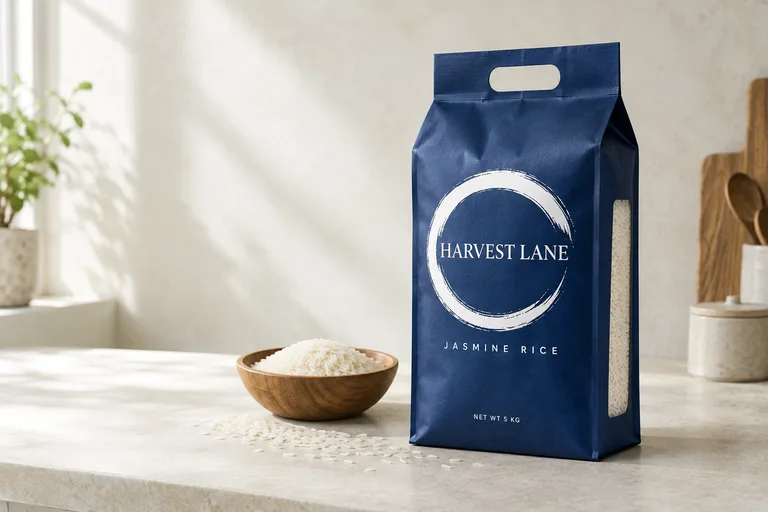
A bag that holds five kilos is a structural problem before it is a printing one.
Start with the fill weight and how the bag is handled between the mill and the shelf. At five kilos and up the bag is dropped, stacked and dragged, so seal strength, handle reinforcement and puncture resistance are the specification; barrier is the easier half.
Built for rice, grain & dry staples
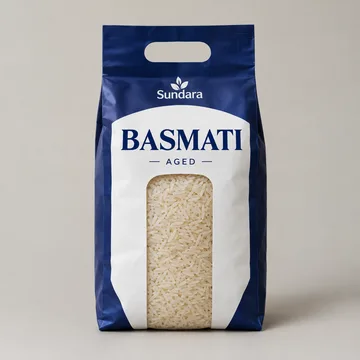
Flat Bottom / Box Pouch
A defined square base and five printable panels for coffee, tea and specialty foods.
Explore Flat Bottom / Box Pouch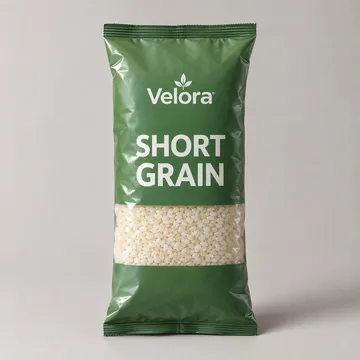
Back-Seal Pillow Bag
A fin seal down the back, with or without side gussets. Efficient on film.
Explore Back-Seal Pillow Bag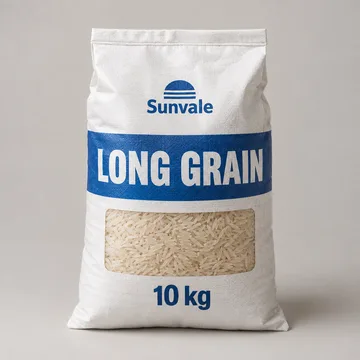
Side-Gusseted Bag
Side panels expand around the fill. The classic large-format coffee bag.
Explore Side-Gusseted Bag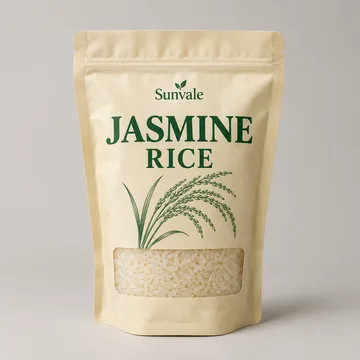
Stand-Up Pouch
A bottom gusset opens into a base for an upright, front-facing shelf display.
Explore Stand-Up PouchRice, Grain & Dry Staples, in five builds.
These are the constructions and fill sizes the plant runs for rice, grain & dry staples. The build is fixed by what you pack; everything printed on it is yours to direct.
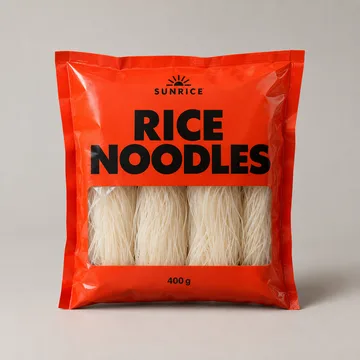
Each one is a construction and a fill size the plant runs for rice, grain & dry staples, shown in a different brand language. Every brand shown here is invented. These are design studies, not photographs of printed customer orders, and nothing pictured is a supplier specification.
One rice bag, four directions.
The band above shows which constructions the plant runs for rice, grain & dry staples. This one holds a single one of them - a flat-bottom box pouch at 2.5 kg rice, the construction we would start you on - printed four ways. Same bag, same size, same plant. The build is not the thing that decides how yours looks.
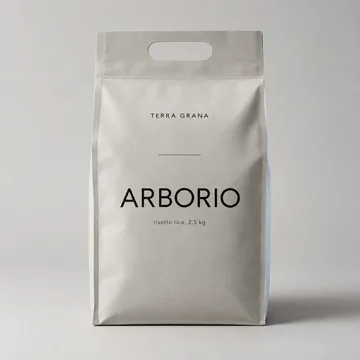
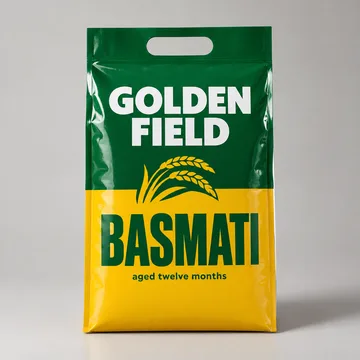
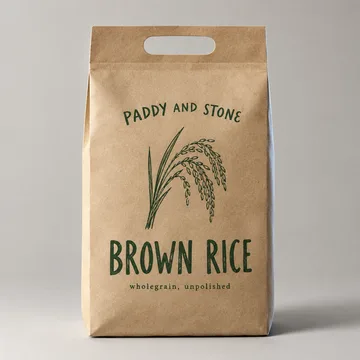
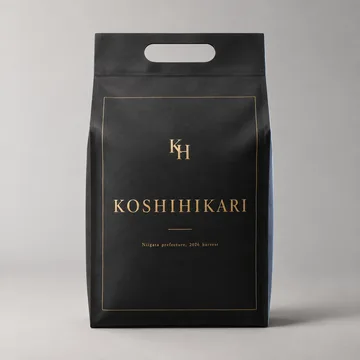
Every brand here is invented and every frame is a design study, not a photograph of a printed customer order. Six more directions on this construction, or start a brief with it.
Why this stack, for this category
A printed polyester face over a nylon layer, sealed with polyethylene. At these weights the failure is mechanical rather than chemical: the bag is dropped, stacked and dragged, so puncture resistance and seal strength decide the structure long before barrier does.
PET12
Catalog page 8 prints this in a menu of outer, middle and inner options under the heading "the material structure can be customized". It publishes no approved combination and no unit for the gauge, so the layer order and the thickness are set with your quote.
PA15
Catalog page 8 prints this in a menu of outer, middle and inner options under the heading "the material structure can be customized". It publishes no approved combination and no unit for the gauge, so the layer order and the thickness are set with your quote.
PE(40/60/80/100/120)
Catalog page 8 prints this in a menu of outer, middle and inner options under the heading "the material structure can be customized". It publishes no approved combination and no unit for the gauge, so the layer order and the thickness are set with your quote.
Where this category lands
| Catalog size | Construction | Catalog fill example |
|---|---|---|
| Custom size / recommend a size | Any | Not published |
| 30*20+8 cm | Not stated in the catalog | 1kg |
| 40*19.5+7.5 cm | Not stated in the catalog | 2.5kg |
| 49*24.5+9.6 cm | Not stated in the catalog | 5kg |
| 32*53 cm | Not stated in the catalog | 5kg |
| 25*58 cm | Not stated in the catalog | 10kg |
| 40*67 cm | Not stated in the catalog | 15kg |
| 42*74 cm | Not stated in the catalog | 20kg |
| 44*77 cm | Not stated in the catalog | 25kg |
| 55*95 cm | Not stated in the catalog | 50kg |
Starting size to review: Share your fill weight and how the bag is handled in transit; final size requires supplier confirmation.
Features
Finishes
See your brand on the pouch.
Free on 5,000+ pieces. A flat $100 fee below it, invoiced only once you approve the brief.